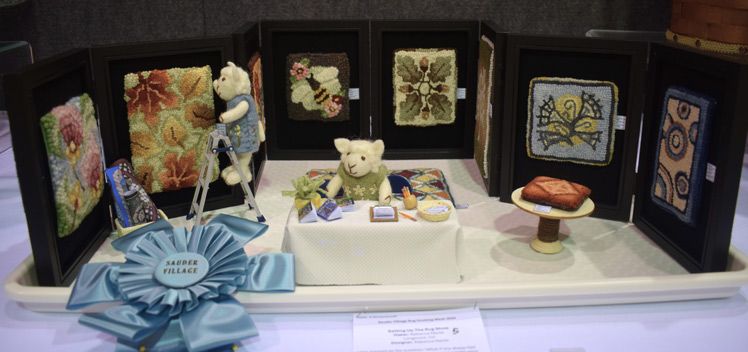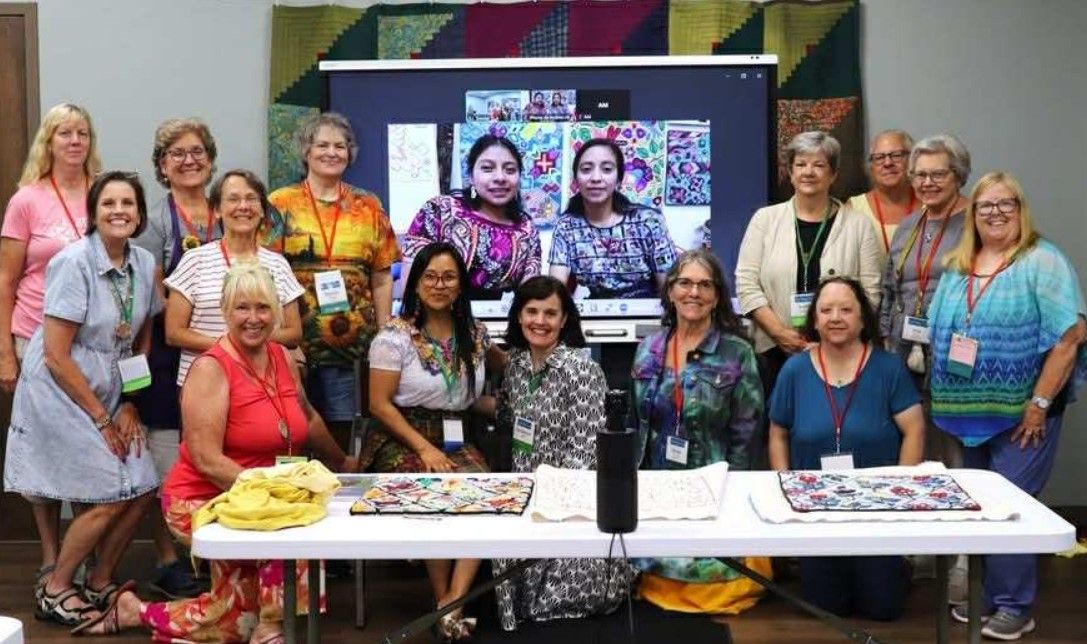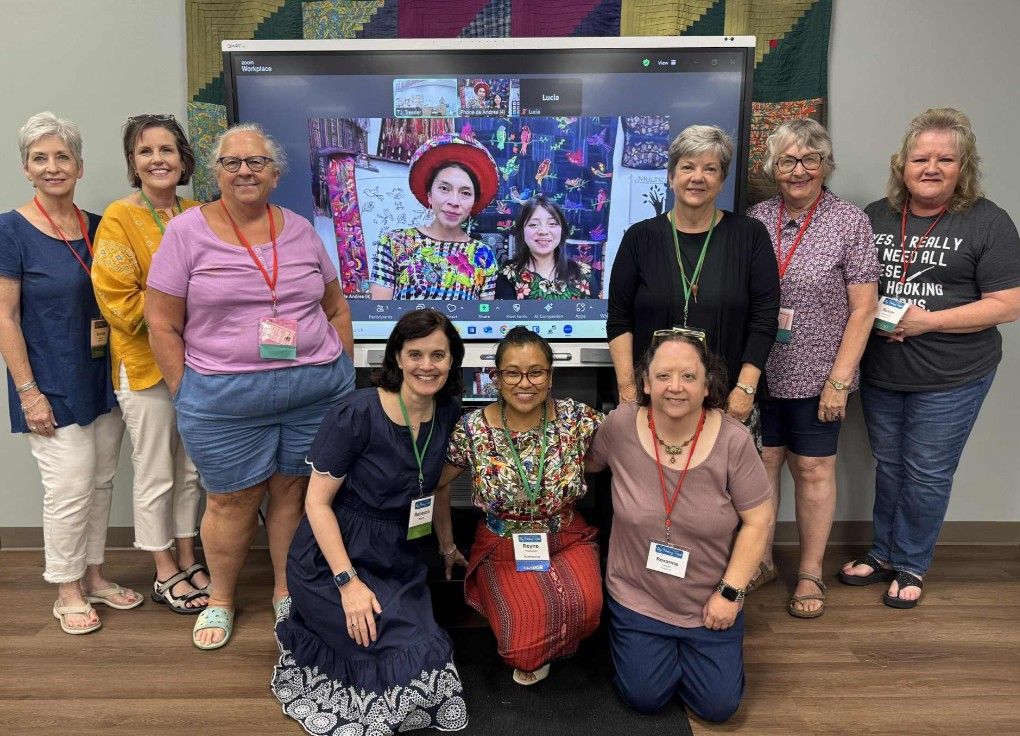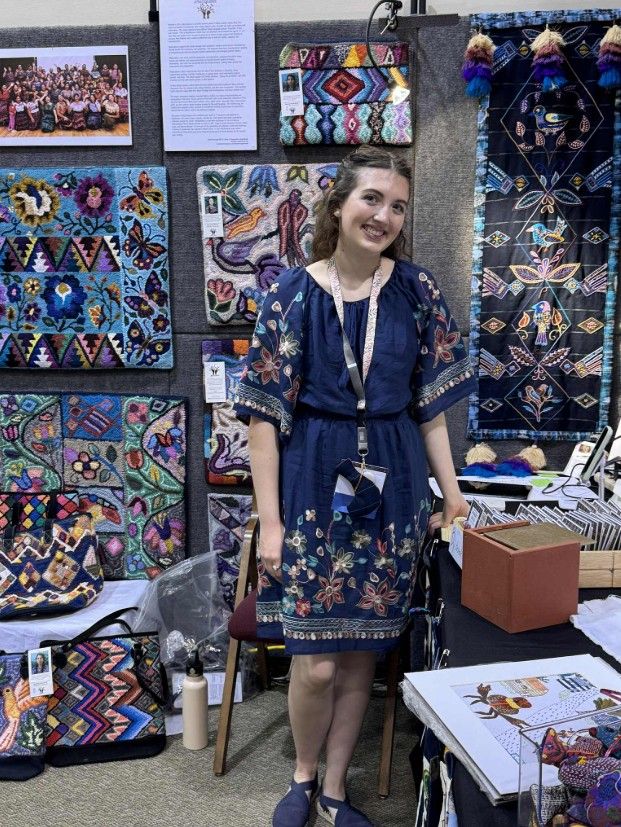
ISSN 2207-001X April 2026
When beginners ask about rugmaking, usually the first question is, “do you need a frame?” There’s no quick answer, because it depends on the rug maker and the technique being used. Most rug hookers using the “traditional” hooking technique, of pulling loops of fabric or yarn through an open weave or using a punch needle, the answer is normally “Yes”!
There’s all manner of wooden and metal rug hooking frames shown online; tabletop, lap frames, frames on stands (either a single adjustable floor support, or four fixed legs) with the frame face being flat or adjustable, some that swivel; not forgetting the early stretcher frames and geared Cheticamp frames.
So many choices! but what it finally boils down to is, availability and cost, particularly the impact of international shipping costs. Some Aussie rugmakers have purchased and shipped or carried home frames from overseas – many have shown ingenuity and made their own.
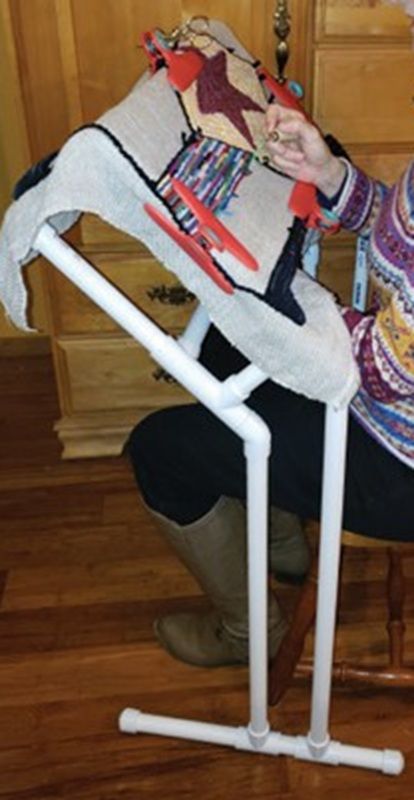
 In early 2018 one of our group members made her own frame from PVC pipe which at the time I shared online in my Blog
When I checked out her source I saw it came from Judy Taylor’s website Little House Rugs and thinking there might be a copyright problem, I emailed Judy. After several emails back and forth I discovered she lives relatively close to my family in Seattle who I’d planned to visit August 2018 after attending Rug Hooking Week in Sauder Village, Ohio USA. Judy invited me to visit, and I spent a very pleasant afternoon at her home & studio. When I arrived she had a PVC frame dismantled so she could show me how it went together which I shared on my return home along with images of her Jacob sheep and Angora goats, raised to provide the wool she spins.
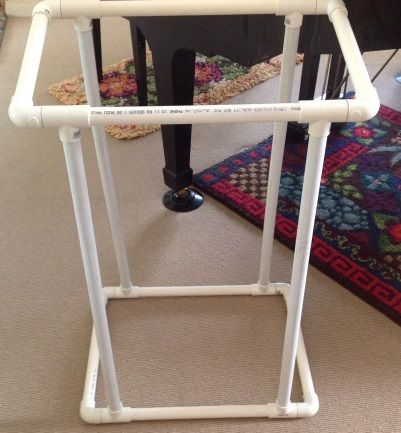
In South Australia, Judith Stephens had also come up with a couple of PVC frames; a folding mini lap frame and one on tall legs.
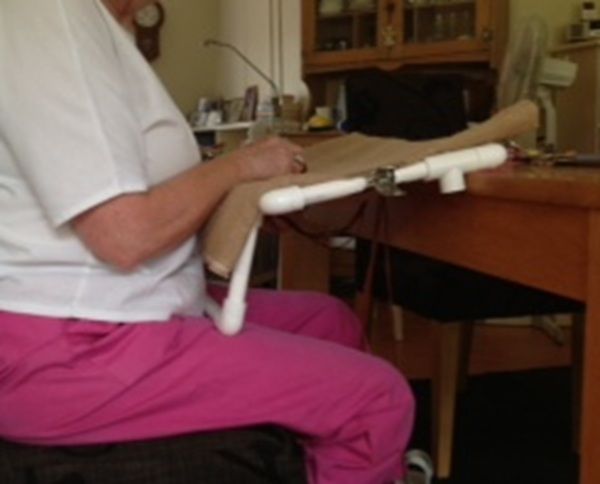
Getting back to whether frames are necessary; in earlier times and cooler climes (Seattle-USA, Tasmania in OZ and in the UK), many rug makers create tension on their backing fabric (foundation cloth) by wrapping the fabric across their lap and tucking the ends of the backing under their legs. In fact Judy Taylor also has a video showing that she started rug hooking this way 30 years ago. Wrapping across one’s lap works well for latch hook, seen here, with a latch hooker from Tasmania working on her own design, also locker hooking and proggy/proddy.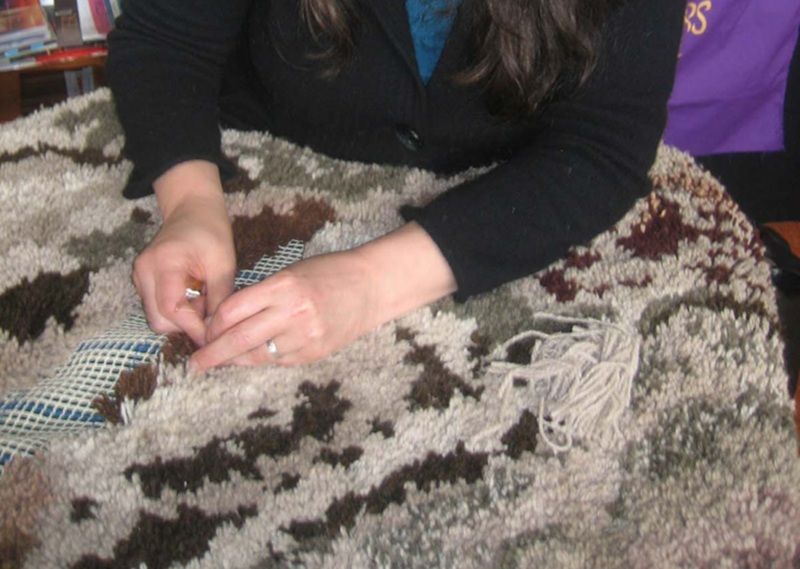
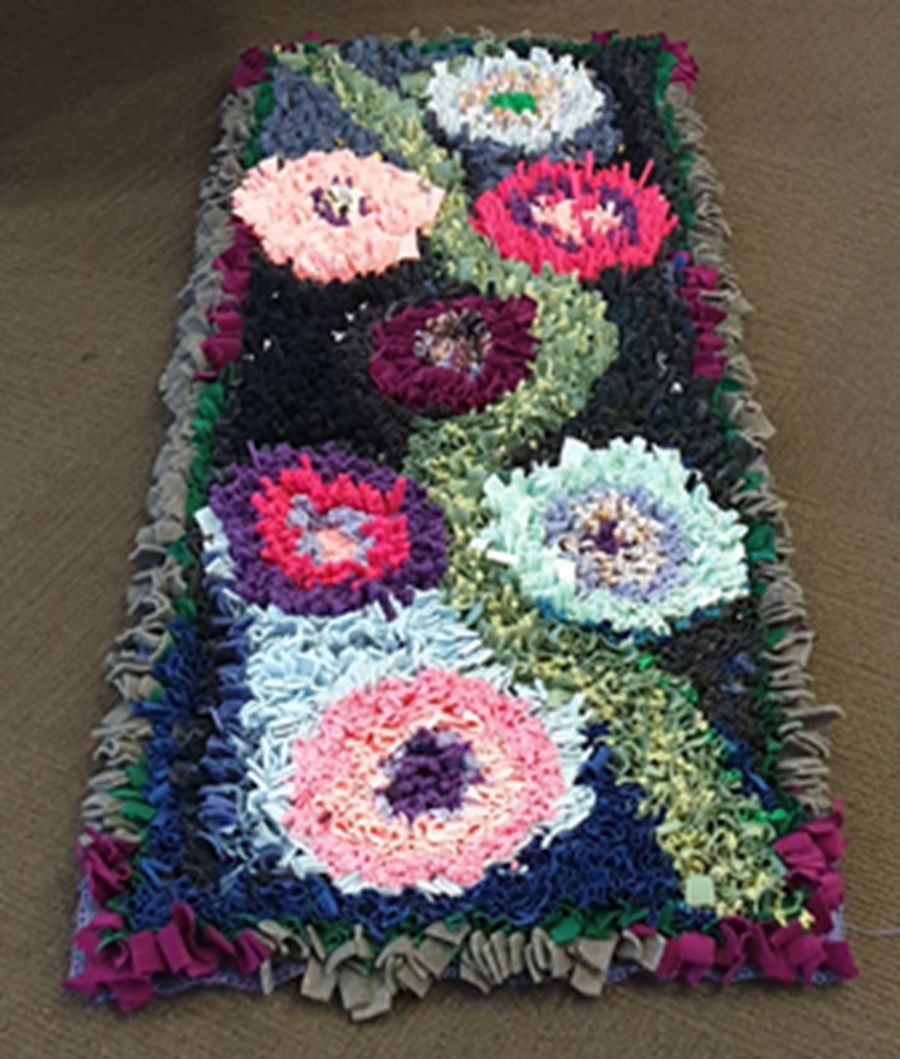
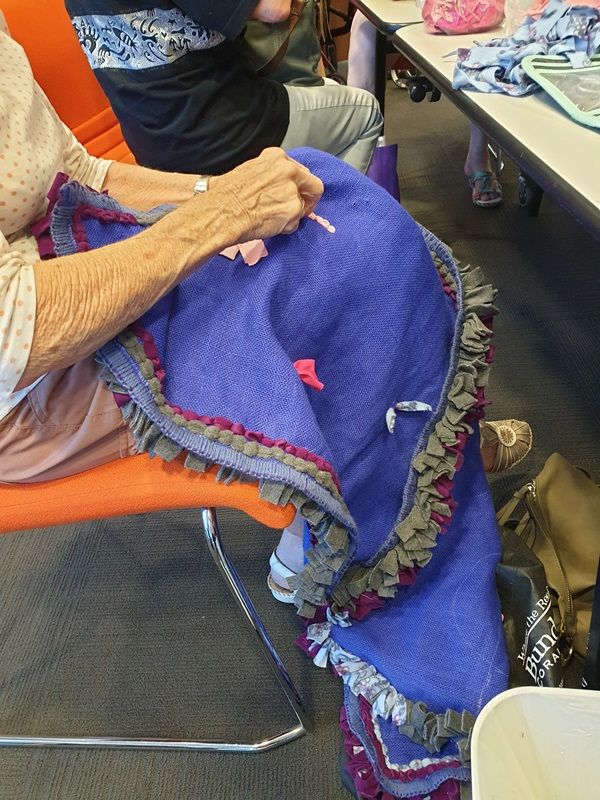
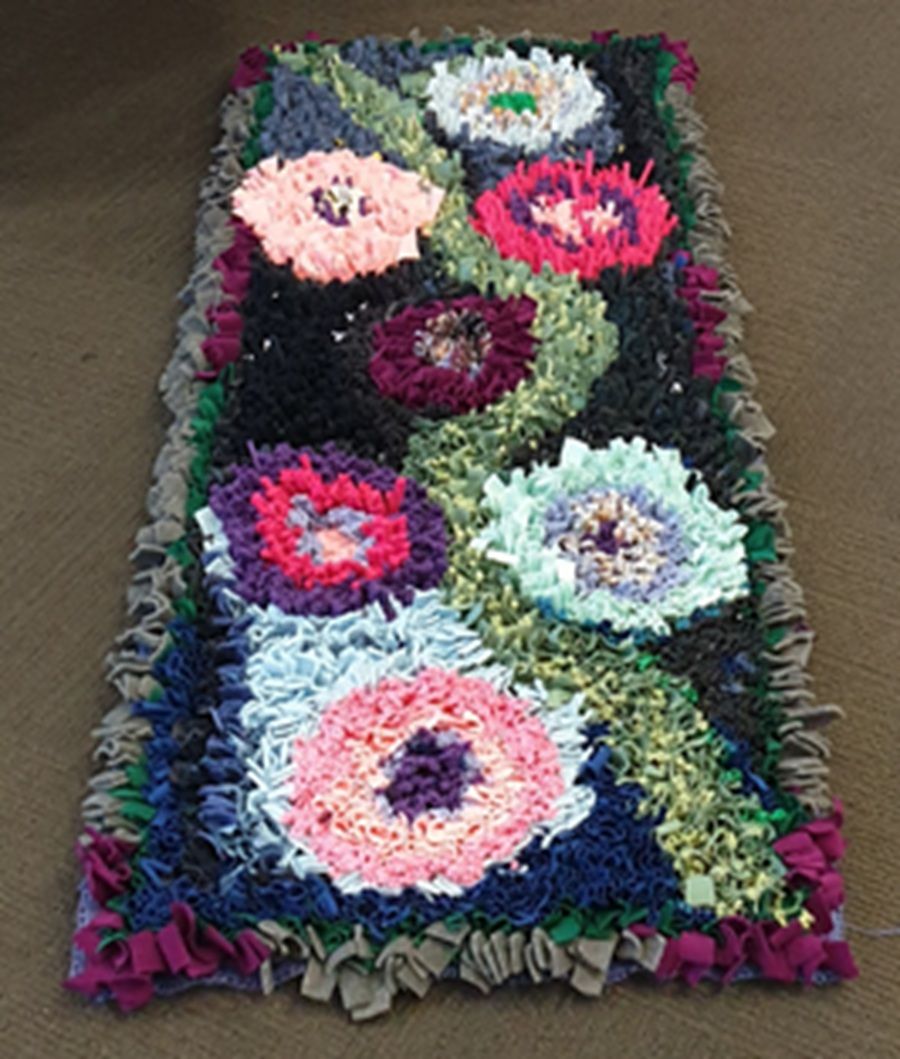
Having said that, some of our Wanneroo group members don’t tension their proggy pieces – here’s Tricia’s water lily rug in the making and the finished product. Sharen usually locker hooks on her lap and moved to table top as it began to grow – a hall runner for very long hallway.
Due to lack of rug hooking resources and suppliers in Australia and costly international shipping we Aussies are good at improvising; The saying, “Necessity is the mother of invention” definitely holds for Australian rugmakers. While our group didn’t invent the stretcher frame which has been in use since the early 1900s, we 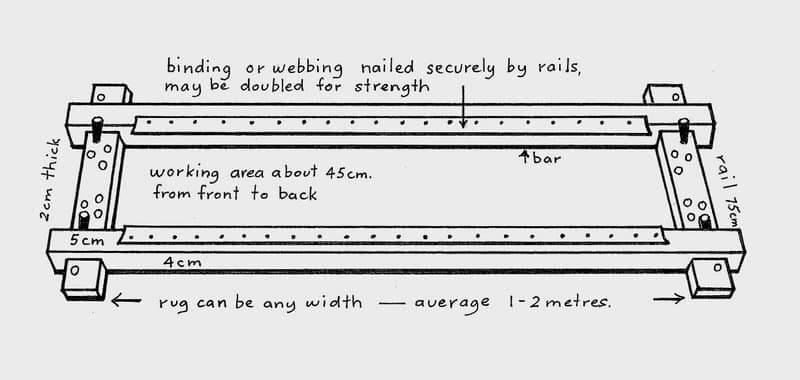 did modify the specifications shared in Miriam Miller’s book Proggy & Hooky Rugs to accommodate six rug hookers at one time – reminiscent of the old quilting bees.
As Crocodile Dundee would have said “That’s a not a frame, THIS is a frame!”
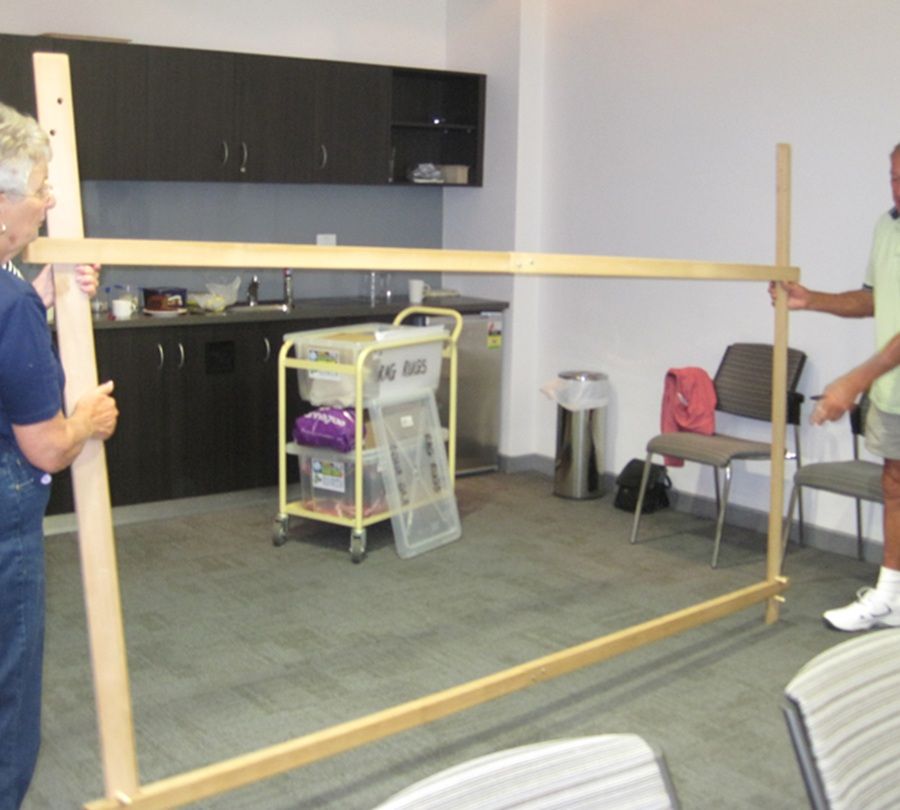
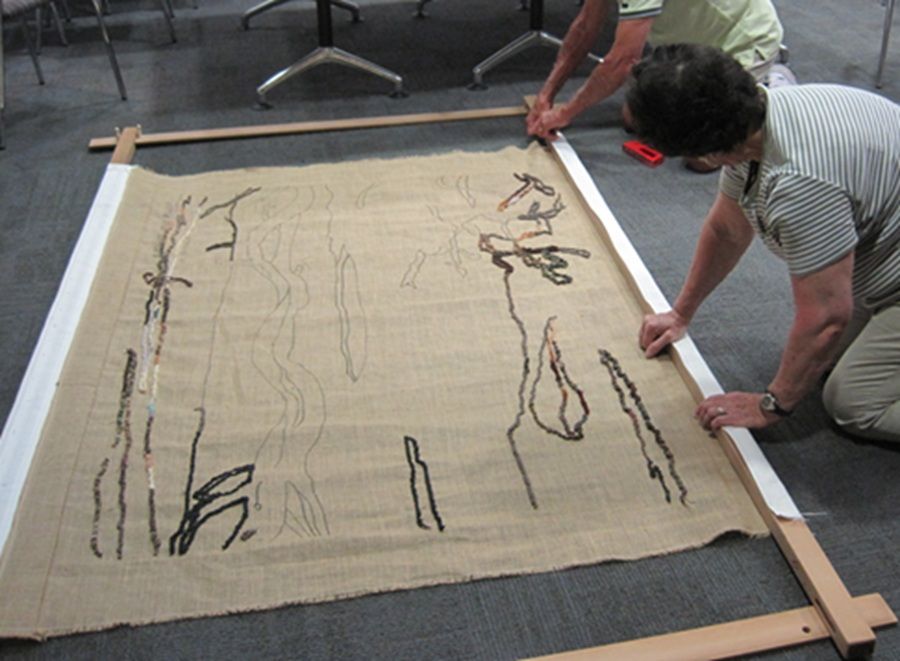
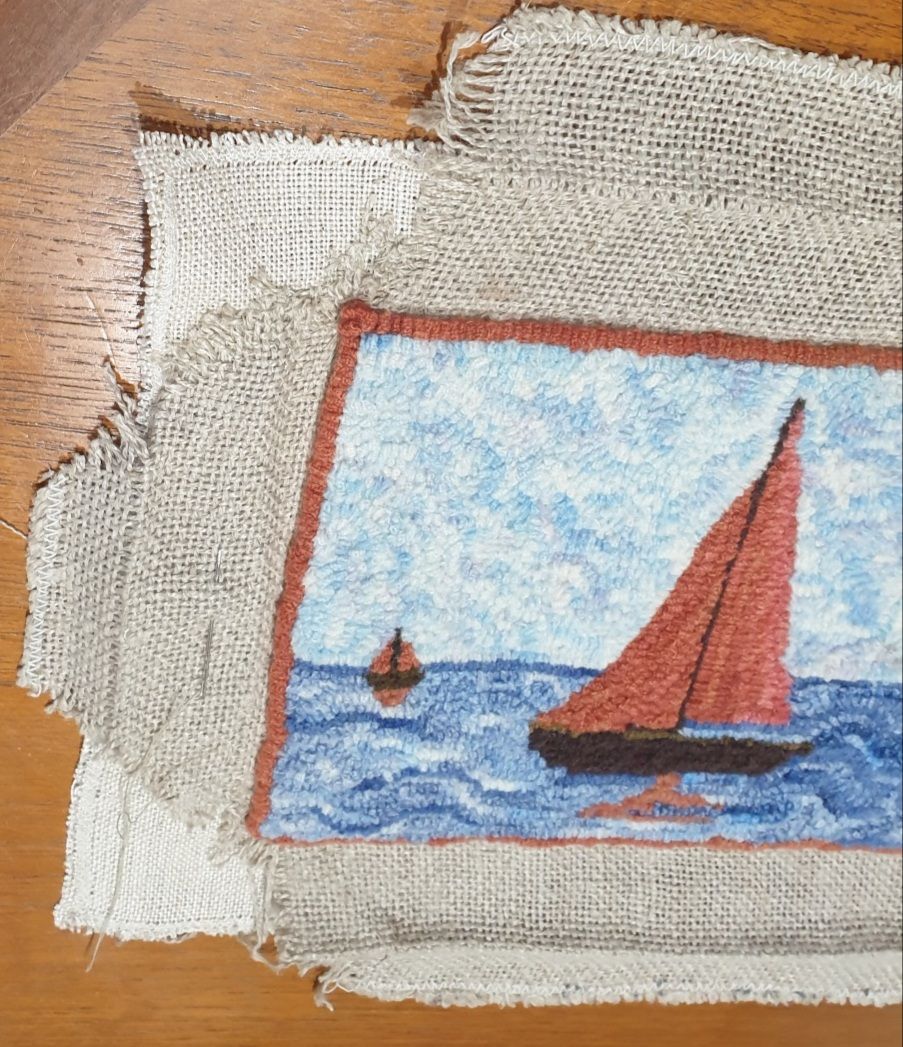
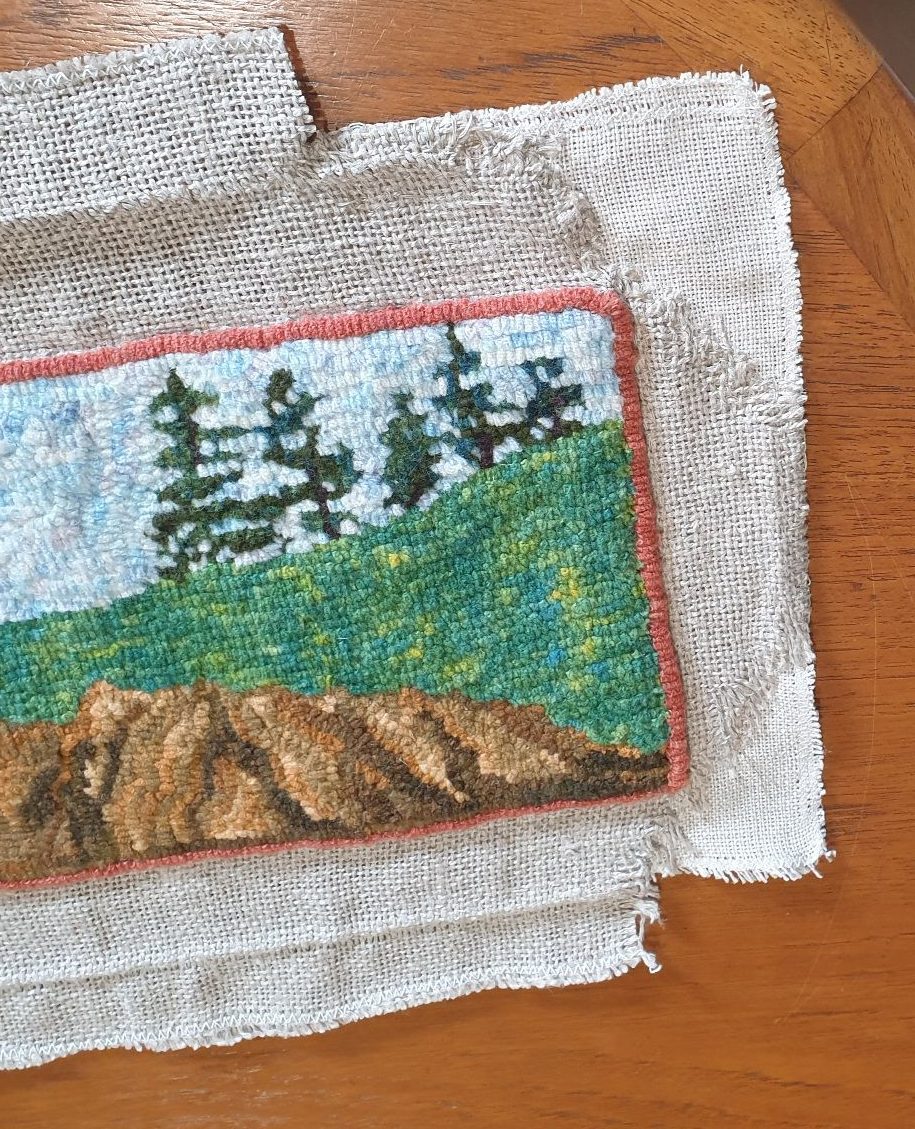
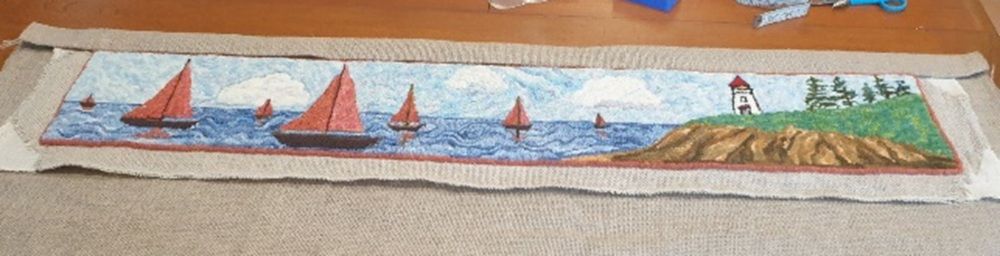
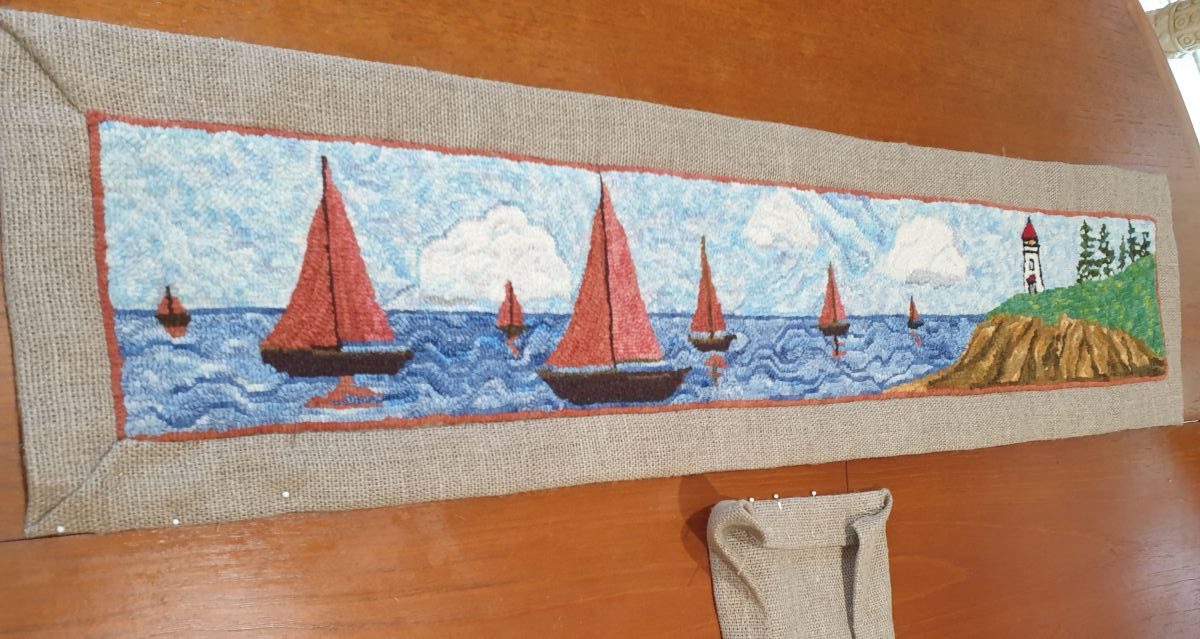
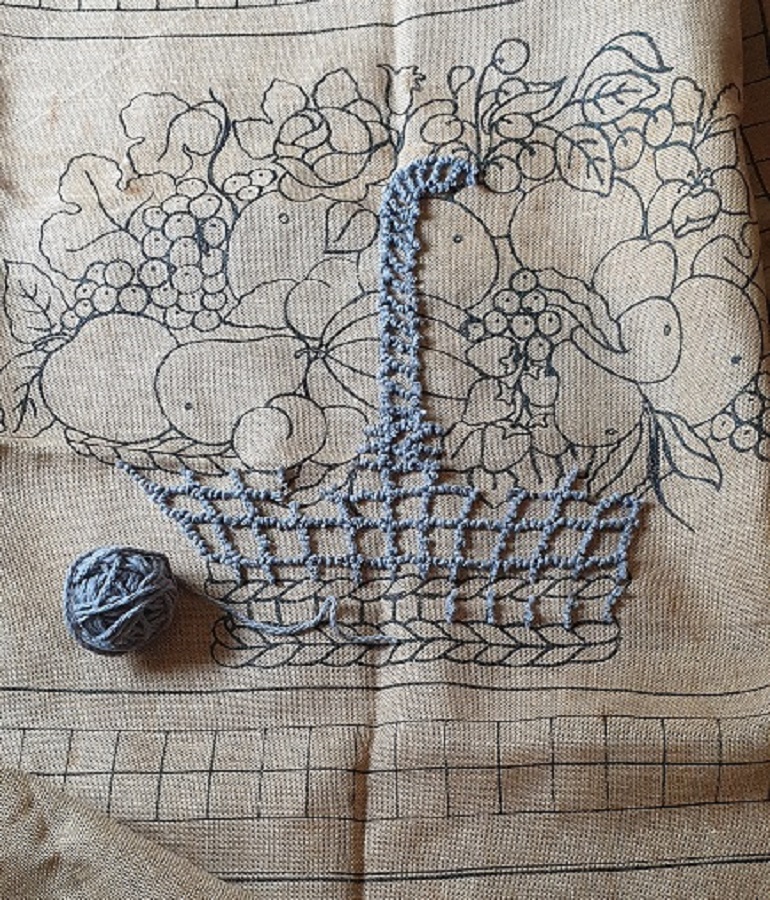
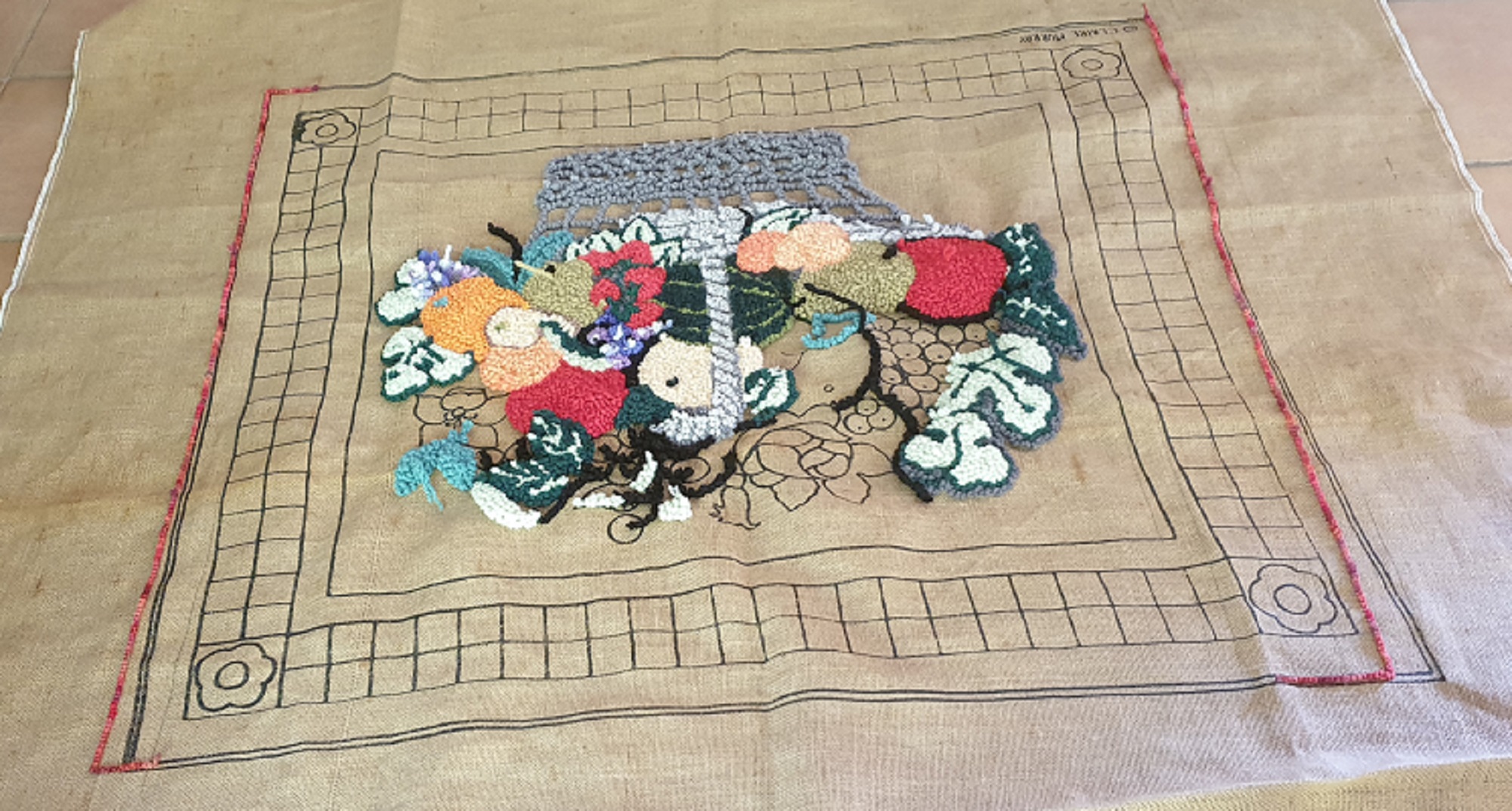
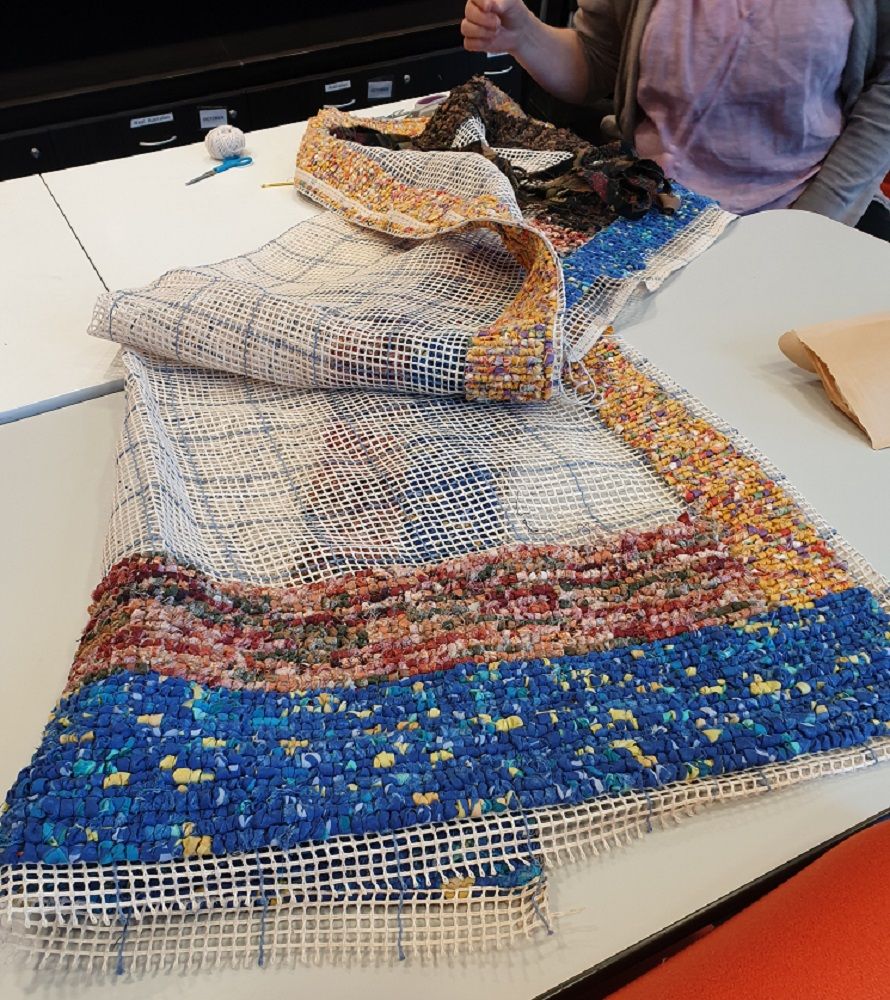
Here’s a progression of images of the frame from start to finish. The Hessian backing was stitched onto lengths of upholstery tape which were then stapled to the frame top & bottom and each week it was laced onto the side bars.
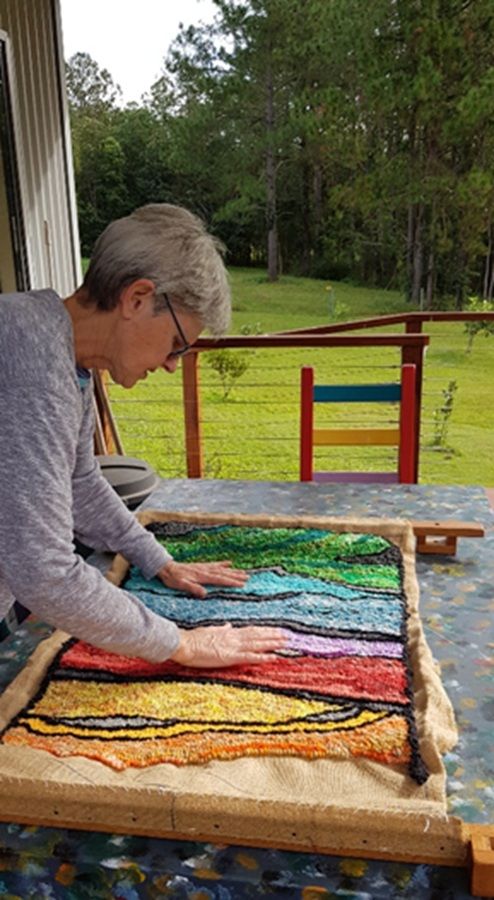
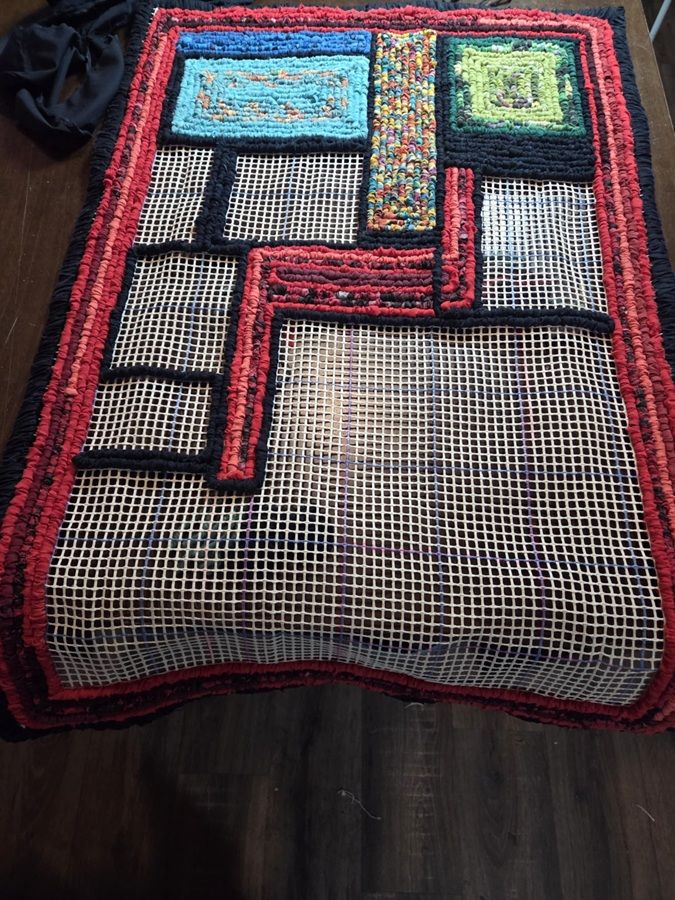
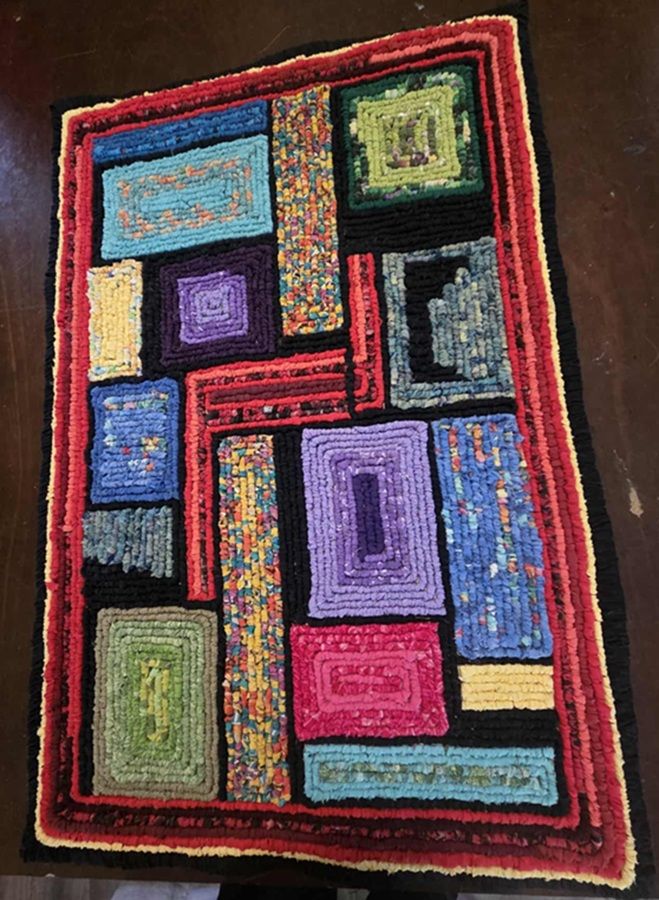
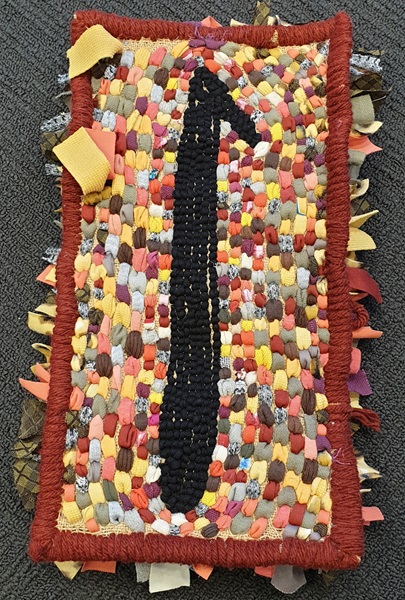
The outline of the design was hooked, then it was discovered that small sections would not show up amongst the shaggy lenths of the proddy pieces, so the frame was turned over and those sections were hooked in wool strips which provided “relief” within the textural work. At the end of each Saturday mornings session the lacing was undone and the piece rolled around the top and bottom bars and tied together so it could be stored as a roll on top of the cabinet in the room where the group met. To accommodate three people working from each side the edges were left rolled – we worked from the middle of the piece unrolling as necessary. The weight of the worked area in the centre created a problem and it became necessary to add another flat board between the 2 tables to take the extra weight, this board just slipped in between the two rolls at the end of the session.
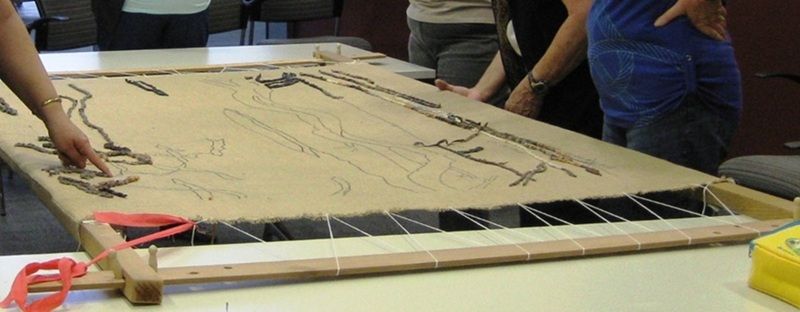
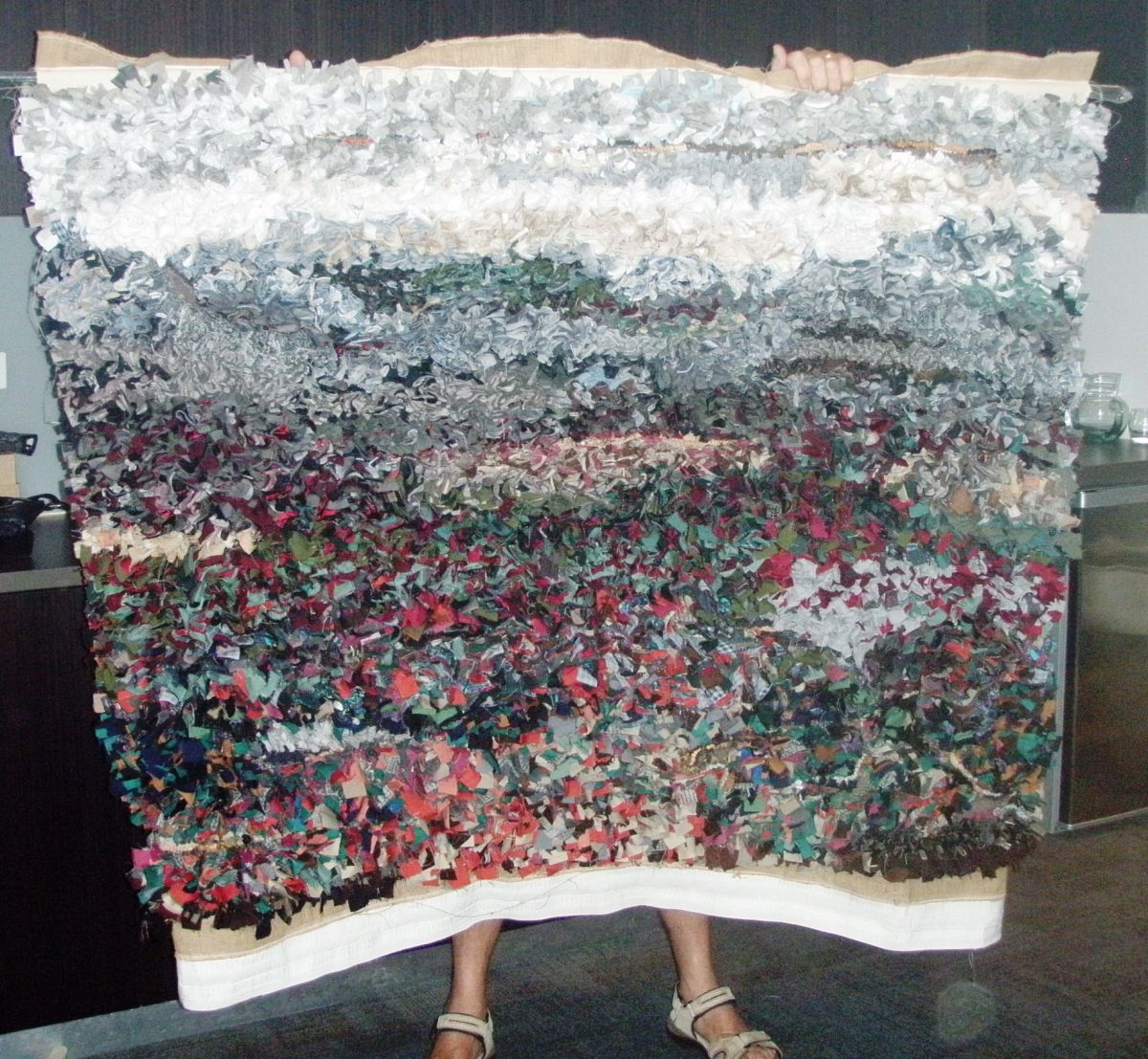
As with punchneedle hooking the design is more evident on the back of the work. The finished wall hanging, seen here with the photo that inspired it taken by local artist Lynne Franke, now hangs in a meeting room at the library in Wanneroo, north of Perth in Western Australia. 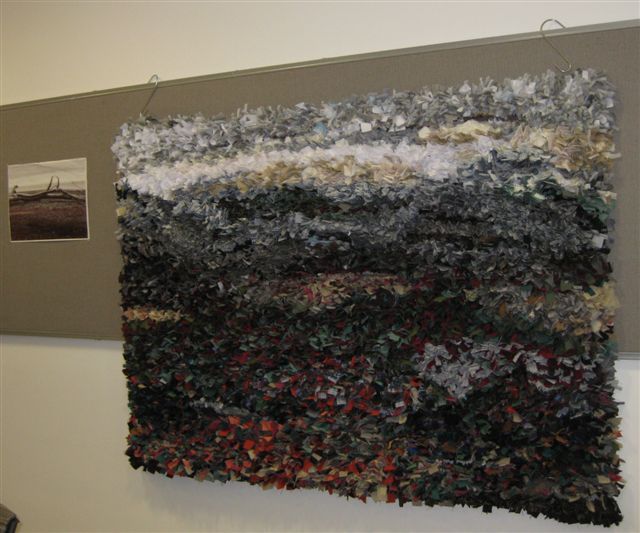
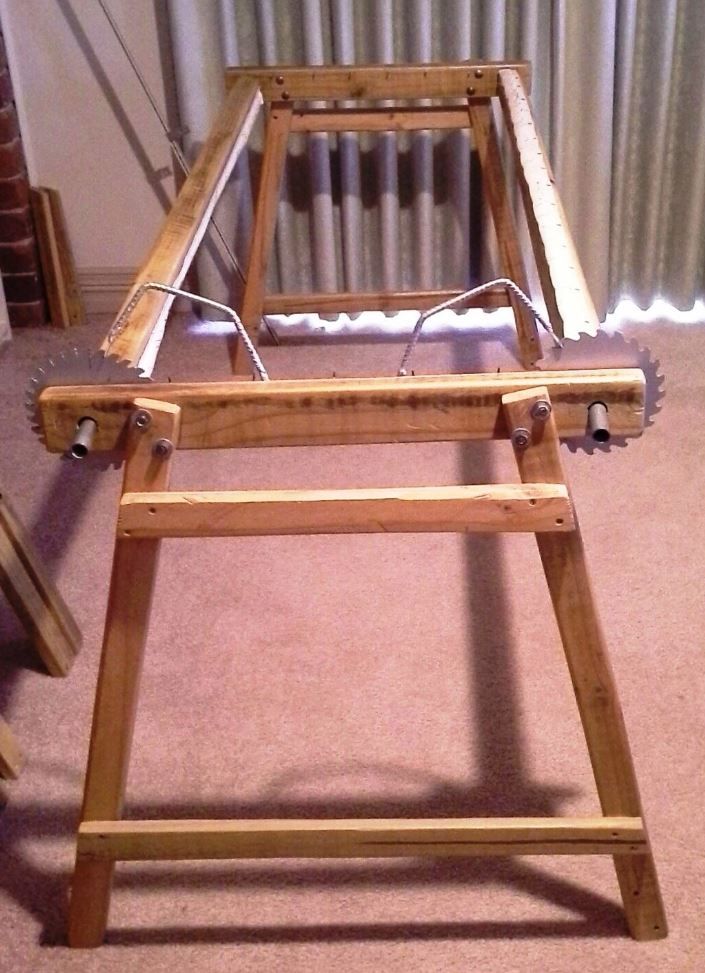
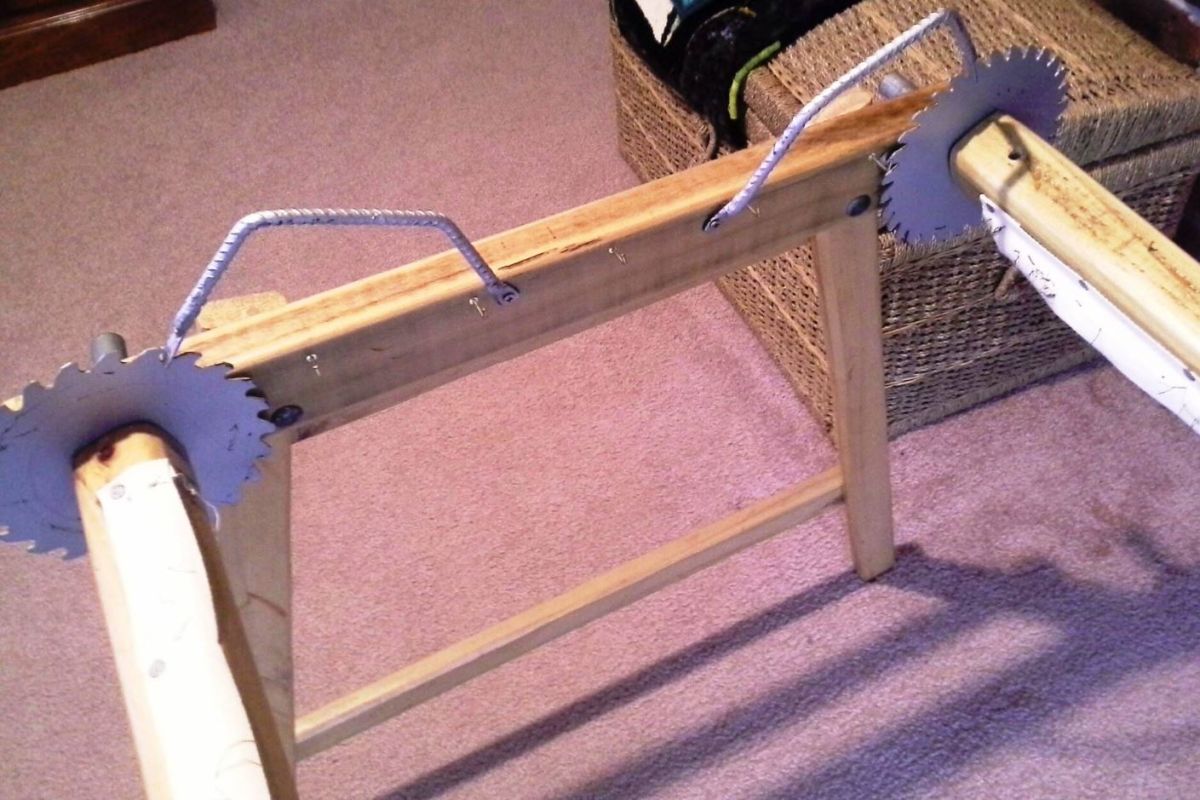
On Australia’s south east coast in Victoria, Chris Norbergen, who hooks with wool strips, had the only Cheticamp frame in Australia. When asked about her Cheticamp frame, which she sold some years ago, Chris said; “Jo, I made it myself with a bit of help from my husband. I got lots and lots of pictures and info online. I took ideas from several different frames. Made it a bit wider than my finished rug, which was 5ft. Used old saw blades, which hubby blunted for me for the gears. Made at a comfortable sitting height, and bob’s your uncle. Done and dusted. Chris’s version of the cheticamp frame I also made an additional set of rails, somewhat shorter for smaller size rugs. Someone got a good deal because it was a one-off.”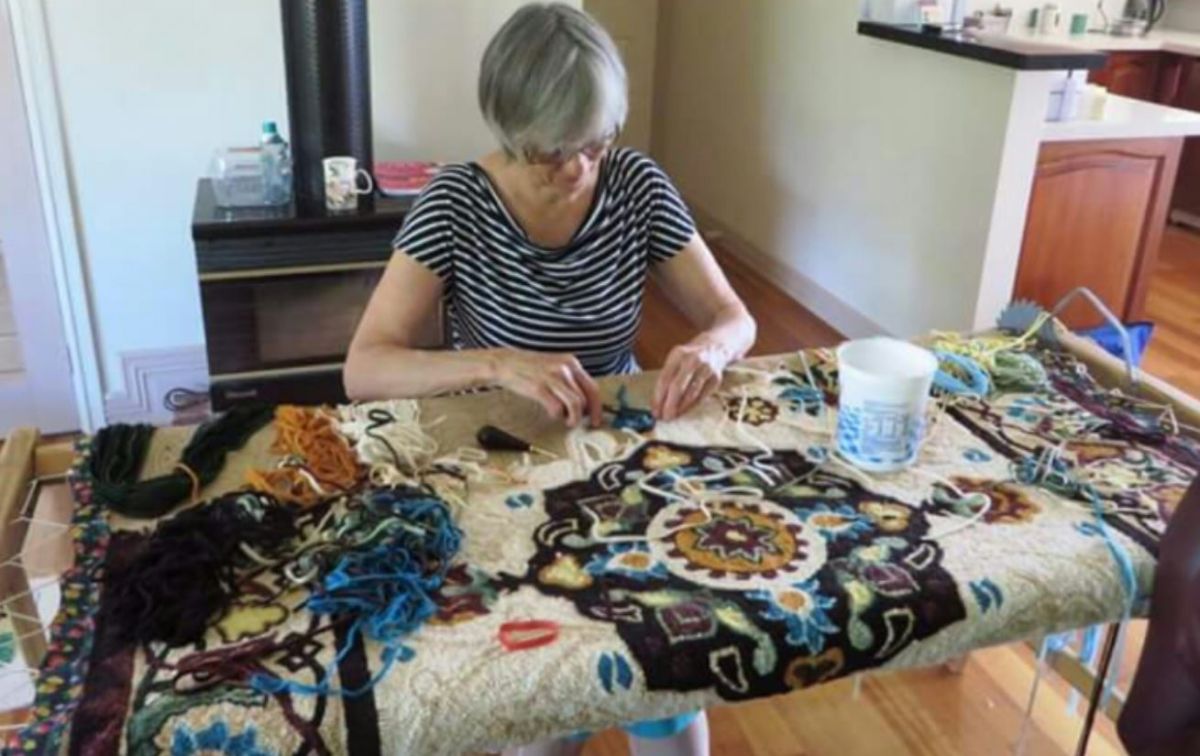
Here are a couple of images of the frame itself – I’ve not seen a real Cheticamp frame, but this looks very much like images I’ve seen.
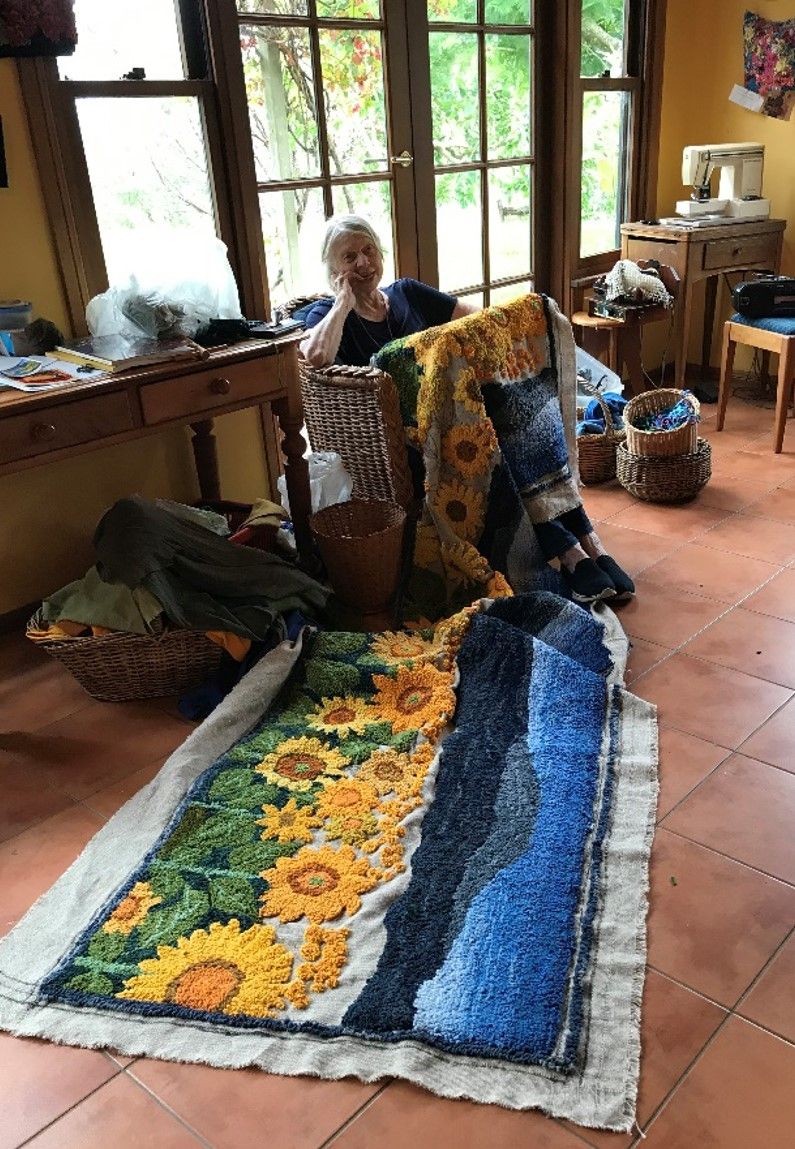
Miriam Miller is from New South Wales, when we met in 2008, she and her group of Narrawilly Proggy Rugmakers all used stretcher frames resting on carpenters’ sawhorses. In fact, the first edition of her book published in 2008 showed only stretcher frames. By the time the second edition came out Miriam had met other rug makers from around the country and overseas and I think I’d convinced her that lap frames were popular, so she added a lap frame image to her book, a Puritan. Now even for larg pieces, Miriam mostly works on a lap frame, a Snapdragon gifted to her by a Canadian friend. Here she is working on her large signature sunflower piece.
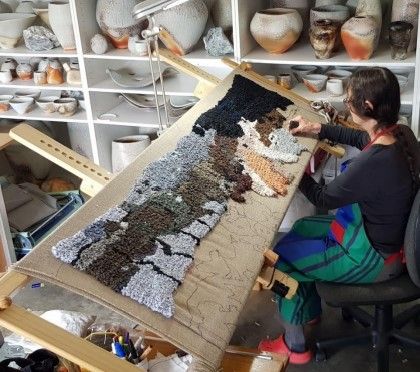
Also from New South Wales, Gail Nichols came up with a frame design to work on her large, hooked wall hangings.

 There is a connection between Gail from New South Wales and Judi Tompkins in Queensland, besides the fact that they both hail from Michigan, USA. When Judi decided to take her creations in a different direction from traditional rug hooking to 3D textile art, her Townsend Cutter went up for sale and found a home with Gail.
These fabric cutters are from the USA, they are very easy to use, and do such a good job, and don’t have blades that need sharpening. Problem is they are quite heavy, especially with carry case and extra cartridges for different sized strips, so are not only expensive to buy but expensive to ship.
I happen to know there’s an original Townsend, like new, very lightly used, available for sale in South Australia. If anyone is interested, they can contact me to be put in touch with the seller.
Judi Tompkins Studio Palimpsest is on the Sunshine Coast north of Brisbane. 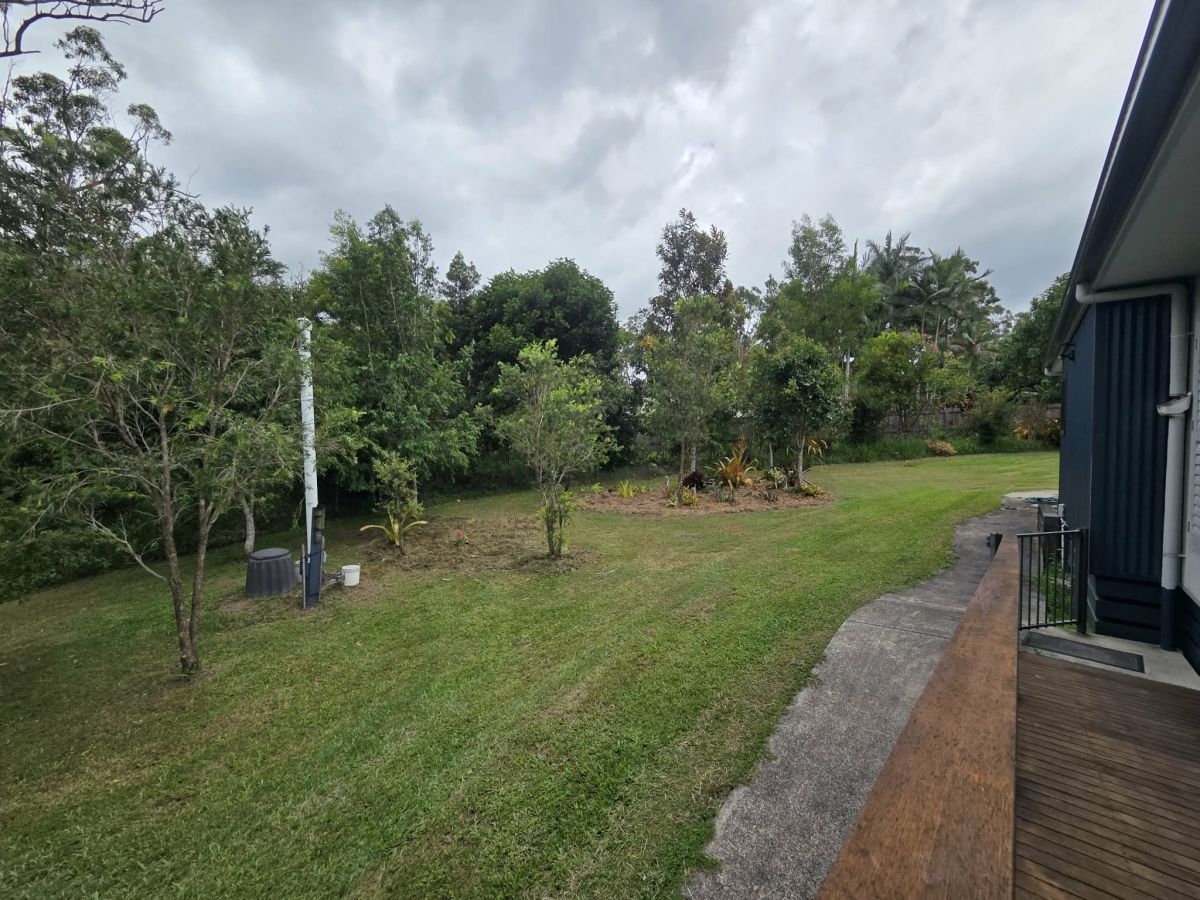 Currently she’s getting ready to be part of the Sunshine Coast Open Studio
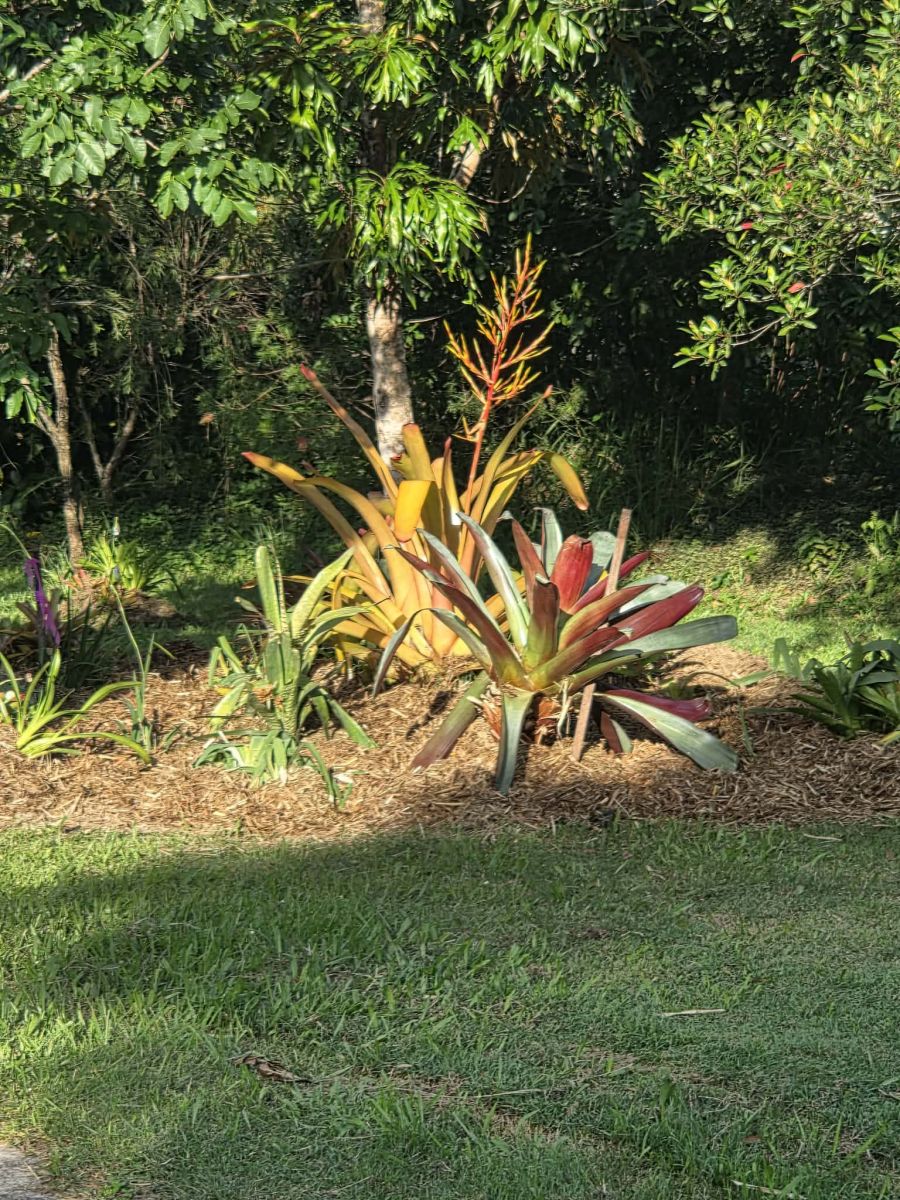 Art Trails to be held from 17th to 26th July. Seems a long way off; but apart from creating new works, her time is taken up planning what to show in her two galleries and work studio, plus maintaining the surrounds which are more than your average backyard.
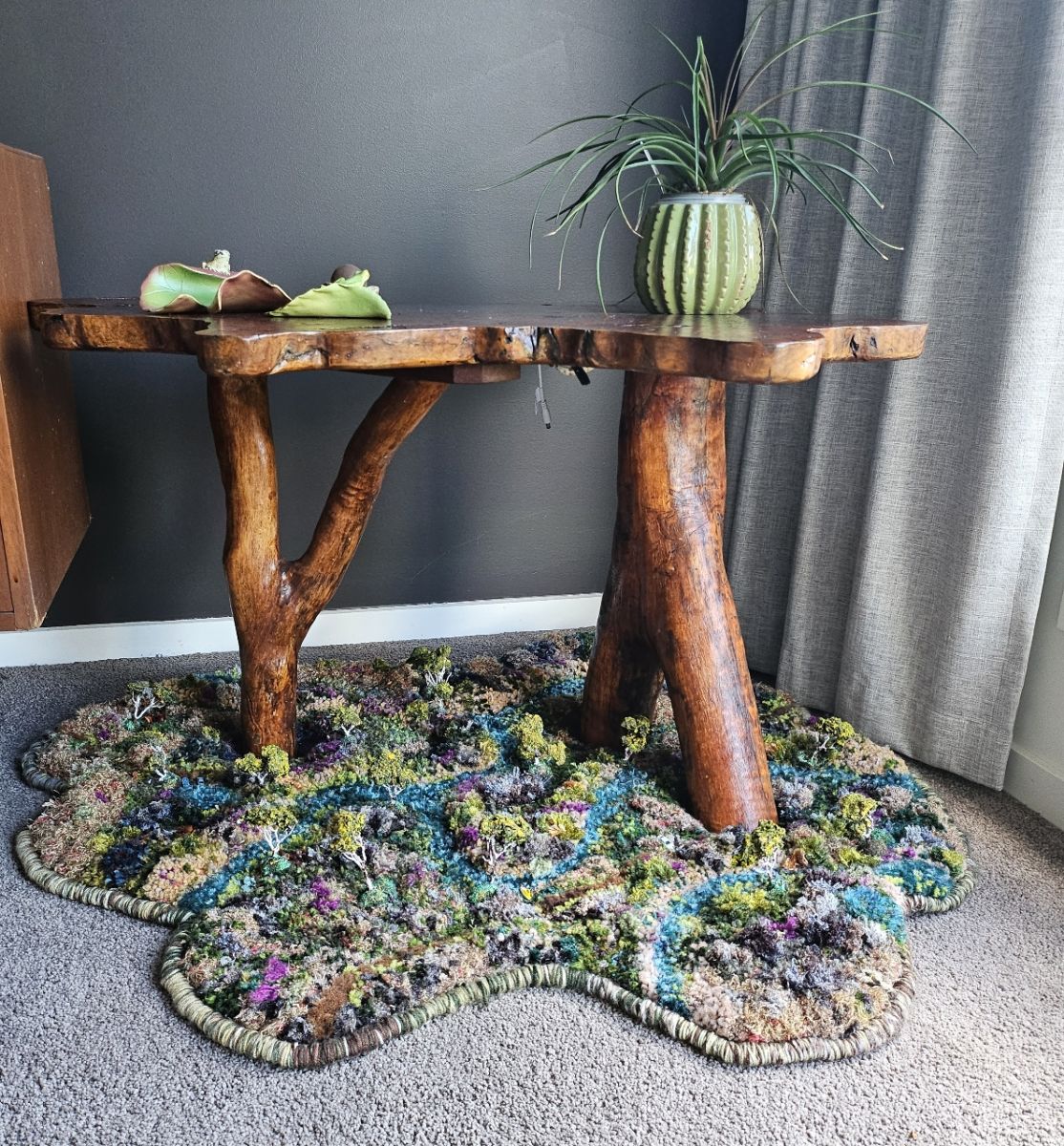
This installation; Wood burl table and mat designed to fit under it created by Judi, sold during Open Studios 2025, Its shown in place at the purchaser’s residence.
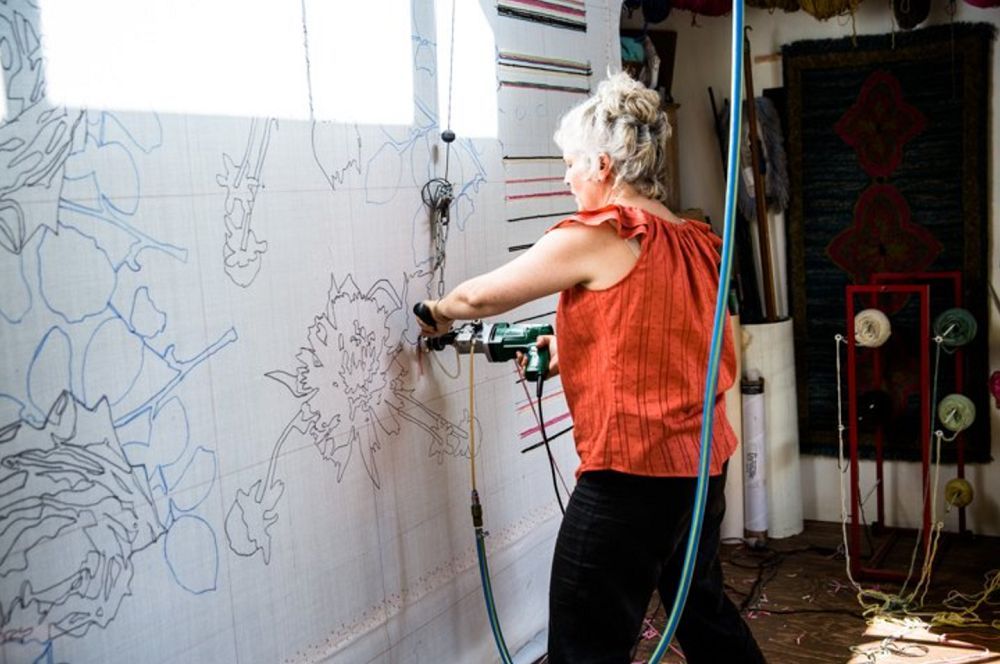 Still in Queensland, south of Brisbane in the Gold Coast Hinterland on Mt Tamborine north, as part of the Tamborine Mountain Arts Trail, on May 2 & 3rd 2026 from 9am to 4pm Bec Andersen is opening her studio
Find out more about the Tamborine Mountain Arts trail here
Bec is the only rug hooking supplier that I know of in Australia, she works on commissions and also gives punchneedle workshops in her studio and holds regular gatherings for her students – the reels that can be seen on her Facebook page look like they’re having such a lot of fun. Check out here on InstaGram. To learn more about Bec Andersen, textile artist, go to her website and subscribe to her newsletter.
This brings us to South Australia, in particular the country town of Strathalbyn, where the Australian Guild was formed in 2008 bringing all the previously mentioned rug hookers and groups together. The last Guild meeting was held there in 2019.
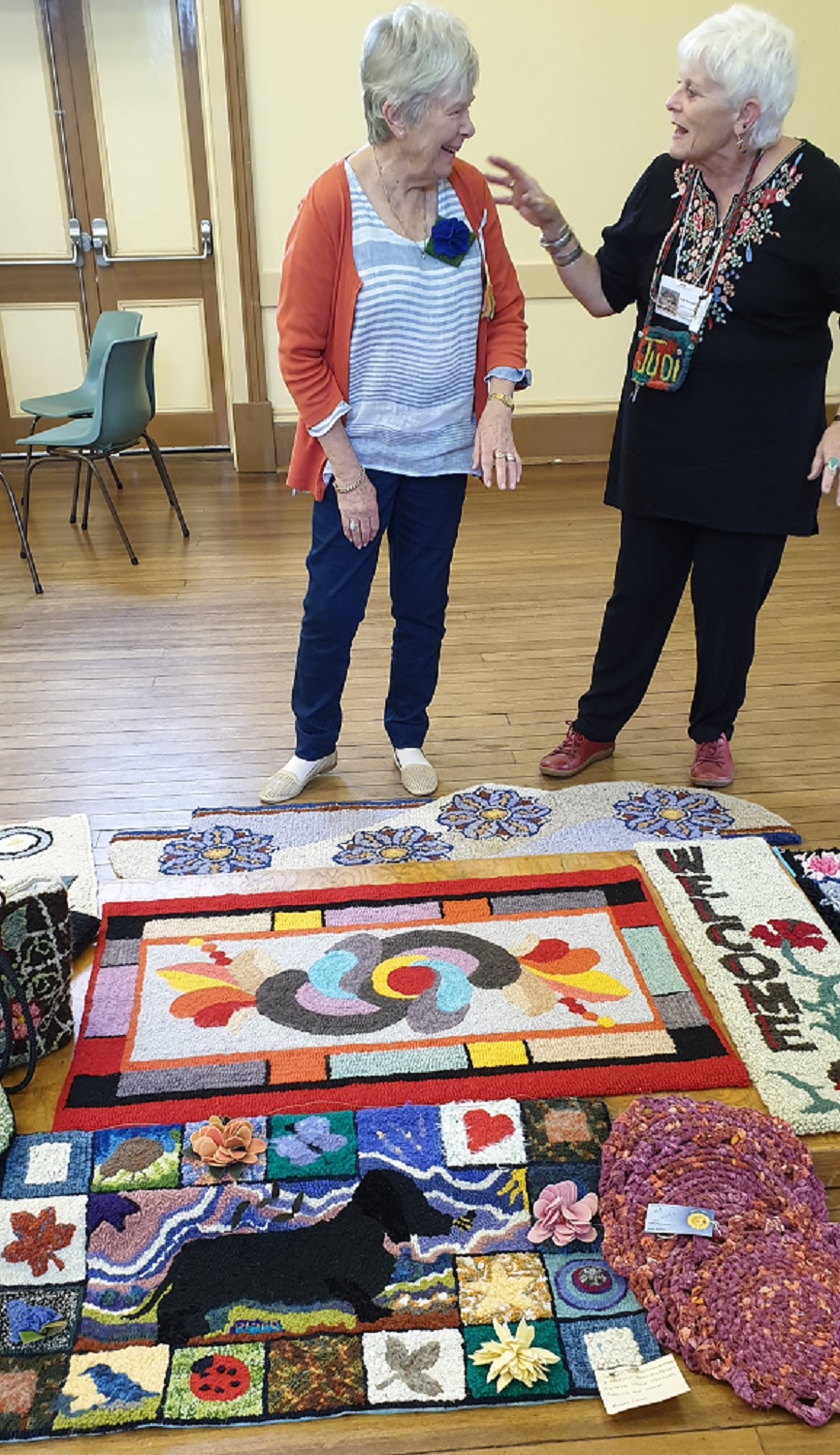
Judith Stephens was the leader of the local StrathMatters group which still meets on a regular basis. You can read about the interesting program of 2019 events hosted by the StrathMatters here.
A further wrap up can be seen here introducing the new board. Sadly Martha Birch from New South Wales who took over as Vice Chair passed away recently. Martha introduced rug hooking to many at Sydney Quilt & Craft Fairs and started a rug hooking group in North Sydney – she will be missed not only by family and friends but also by the rug hookers she inspired.
After years of designing and making rug hooking frames and organizing events, Judith still attends the Strathmatters group however not as the leader, her time is now mostly taken up with her other love, music. As a piano, violin and viola teacher in the past she has joined a recorder group. From what I’ve heard of the price mentioned for her new instrument, these are not your typical school recorders.
Strathalbyn was also the location for the 2012 Triennial Conference of TIGHR (The International Guild of Handhooking Rumakers) where 75 visitors from overseas stayed at Dunreath Homestead.
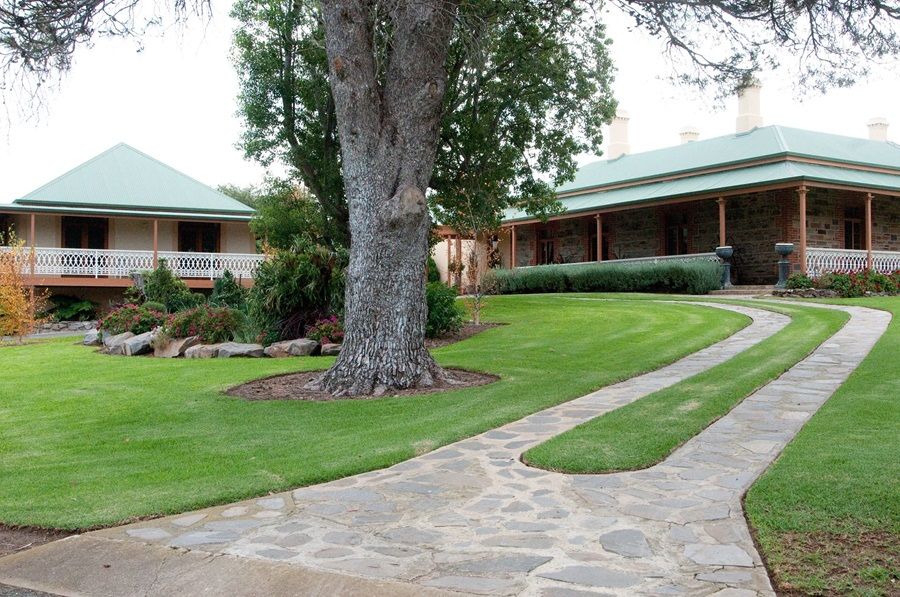
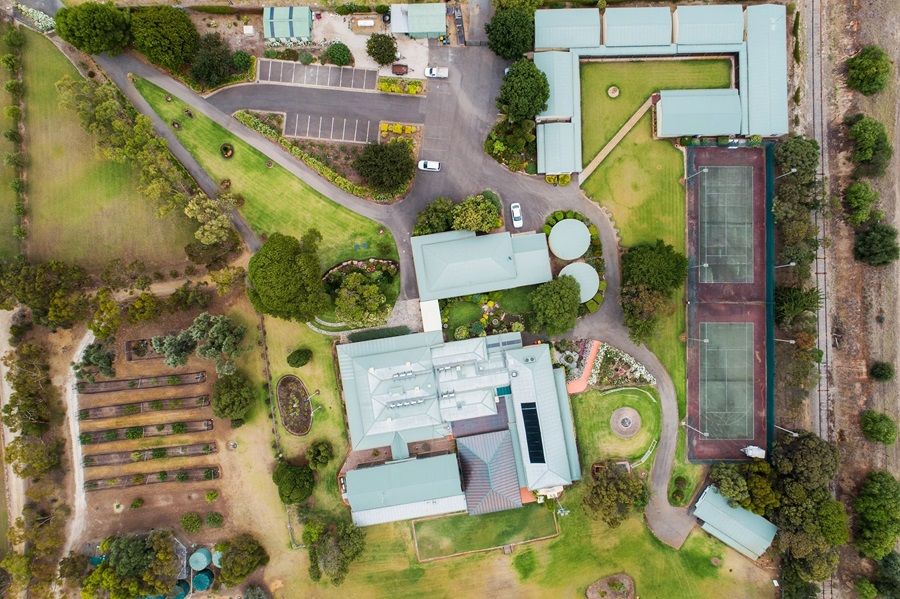
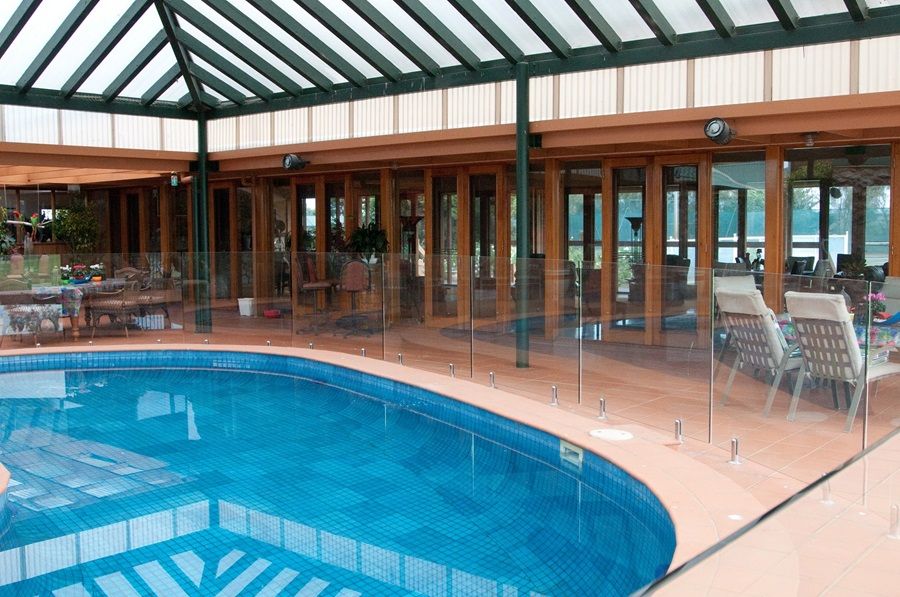
Ausssie rug makers who were billeted around town, joined theinternational visitors for the activities held in areas around the pool and meeting rooms looking out onto the countryside. It was arranged so all participants could take part in every event. After the Conference some of the international visitors stayed on over the weekend to give workshops in different traditional rugmaking techniques; while others went with Miriam back to Narrawilly in NSW where the Narrawilly Proggy Rugmakers hosted special events.
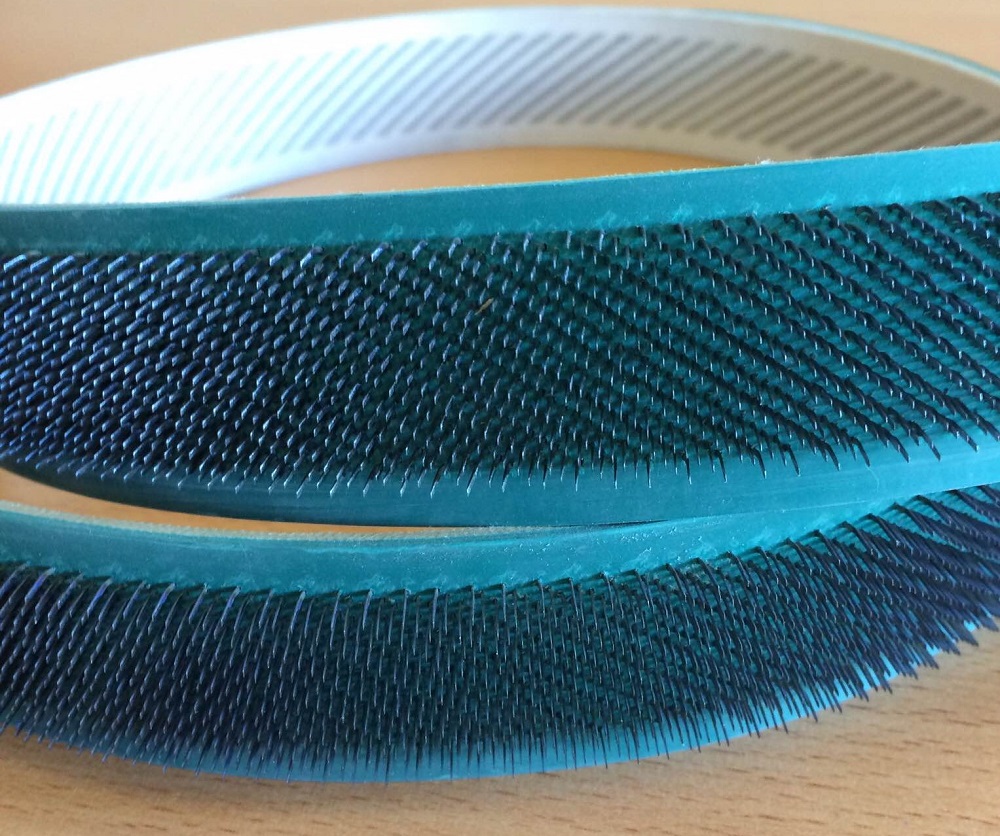
Getting back to frames, most rug makers will tell you that the backing should be stretched onto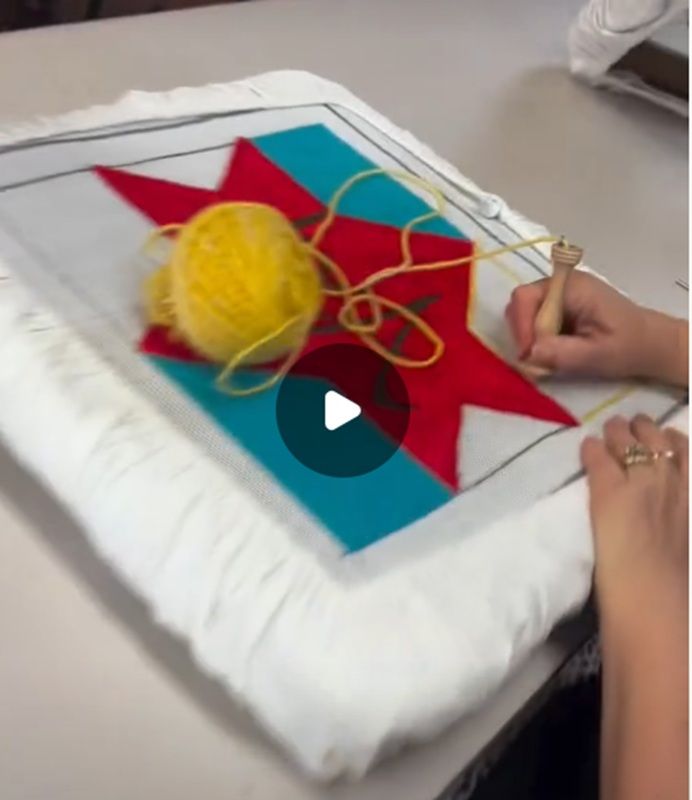 a frame, ‘drum tight’. Begging the question – how to keep the backing fabric tight on the frame? Some swear by metal gripper strips, others hate them! Punch needle frames usually have gripper strips that completely cover the edges of the frame; to avoid damage to hands and arms an elastised cover is often used over the edge of the frame as shown in this image taken from a video of The Happy Hookers in Bec Andersen’s Studio, on Mt Tamborine, QLD.
When it comes to moving your work on the frame, grippers are leathal on previously hooked loops of wool yarn, not so bad on strips of wool frabric. To avoid having to move their work, some Punch needle rug hookers use larger frames as can be seen in this fun video of Bec Andersen’s Happy Hookers showing off their work on Instagram.
Who would have thought so much could be written about rug hooking frames without even mentioning the standard frames for sale in the Northern Hemisphere. I’ve managed to gather quite a collection of different types of frames on my trips to the USA to visit my family. I have two favourites, both with grippers, a Pittsburg folding frame that goes with me on a Saturday morning because it’s so light and easy to pack; the grippers face into the plastic base. At home I use a Fitzgerald wooden hex shaped frame that swivels and has stand that I can adjust height and angle to me but… now that I’m using more wool yarn than wool strips I’ve joined the battle of trying to move my work without the grippers constantly causing a problem. So maybe I’m ready for a PVC frame to add to my other locally made frames, this is what prompted me to look back at Judy Taylor’s story.
I hope you enjoy my ramblings about using or not frames to work on – there’s a whole other discussion about “framing” your work!
Happy Hooking and Creating to all
To replicate fine shaded tapestry pieces, working with finer strips of wool fabric or punching with yarn most rug makers will tell you that the backing should be stretched onto a frame, as ‘drum tight’ as possible. Begging the question – how to keep the backing fabric tight on the frame?
Some makers swear by metal gripper strips; they certainly do a good job of keeping backing fabric tight, and most punch needle rugmakers use frames that have gripper strips completely covering the edges of the frame.
Gripper strips are either loved or hated; due to the damage caused to hand and arms and the difficulty when using wool yarn, to move work in progress, besides their limited availability and cost.
The prickle damage to arms can be avoided by using an elasticised cover over the edges of the frame once the backing has been stretched into place. To avoid having to move their work, some Punch needle rug hookers use larger frames.
Those working with wool yarn using smaller faced frames with gripper strips have come up with various ways to avoid the grippers snagging the wool yarn beyond the “careful removal” (slowly pulling out, away & up).